Early Skin Lymphoma Cleared With Light Therapy. Patients Who Kept Going Stayed Clear Far Longer.
Mycosis fungoides is the most common lymphoma of the skin. It’s a cancer of T cells, a type of white blood cell, that shows up in the skin, and in its early stages it usually looks like flat, scaly patches or slightly raised plaques that are easy to mistake for eczema or psoriasis. Most people diagnosed early never progress beyond the skin, but the disease tends to come back.
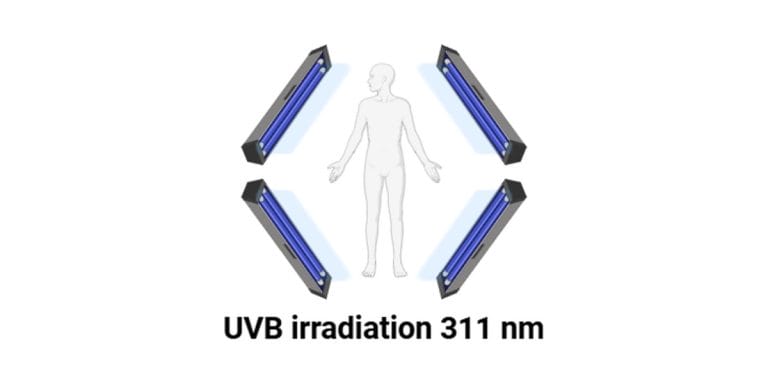
Narrowband UVB is one of the standard skin-directed treatments for early mycosis fungoides, alongside topical steroids and other options a dermatologist or oncologist may choose. The harder question has always been what to do once the skin clears. Stop the light and watch? Or keep treating, less often, to hold the remission?
New data from a team of dermatologists led by Myoung Eun Choi points toward the second answer, and suggests that more maintenance sessions went with longer remissions.
What The Study Looked At
The researchers followed 115 patients with stage I mycosis fungoides, meaning the disease was confined to patches or plaques on the skin, who had reached complete remission with narrowband UVB. Complete remission here means the skin was clear on examination.
Getting there took real commitment. The median patient needed 18 months and 138 narrowband UVB sessions to clear.
After remission, 76 patients went on to maintenance phototherapy, and 39 did not. Those on maintenance continued for a median of 12 months, with a median of 36 sessions. More than half of them (55%) kept it up for a year or longer.
What They Found
The difference between the two groups was large.
- Relapse: 31.6% of patients on maintenance relapsed, compared with 74.4% of those who stopped.
- Time in remission: the median relapse-free period was 63 months with maintenance and 14 months without.
- Risk of relapse: in the authors’ analysis, maintenance was linked to roughly a 69% lower risk of relapse (hazard ratio 0.31).
The researchers also looked at whether the number of maintenance sessions mattered, and it appeared to. The more sessions a patient had, the lower the risk of relapse than for patients with fewer: a hazard ratio of 0.33 at 10 or more sessions, 0.23 at 24 or more, and 0.13 at 56 or more. Splitting the maintenance group into thirds by session count told the same story.
Disease stage mattered too. Patients with stage IB disease, where patches or plaques cover a larger share of the skin, relapsed more often than those with stage IA.
What The Study Can’t Tell You
This is a look back at patients who were already treated, not a trial in which patients were randomly assigned to maintenance or no maintenance. That matters for how much weight the numbers can carry.
Patients and doctors chose whether to continue, and people who stayed on maintenance may have differed in ways the study didn’t capture. The analyses in the posted supplement compare one factor at a time and aren’t adjusted for others, though the full paper may include adjusted results.
The session counts also raise a subtler problem. A patient whose disease came back soon after remission had little time to build up maintenance sessions, while someone who stayed clear for years had plenty. Some of the link between more sessions and fewer relapses could come from that alone, rather than from the light. The large gap in relapse rates is harder to explain away, but the dose-response pattern should be read with this in mind.
The cohort was also fairly young, with a median age of 42, and the full paper with its methods and authors’ discussion wasn’t yet available when we wrote this.
It Fits With Earlier Work
The finding isn’t new. With 115 patients, this cohort is larger than the earlier studies we found, and it’s the first we’ve seen to examine how many maintenance sessions patients had.
A 2014 study of 31 early mycosis fungoides patients treated with narrowband UVB reported maintenance for a median of 12 months after complete response; 11 patients (35.5%) relapsed. A 2021 study from Bangkok, covering 61 early-stage patients treated with narrowband UVB or PUVA over 17 years, found that maintenance lasting more than six months was linked to a significantly longer relapse-free interval. Its authors concluded that at least six months of maintenance seems to prolong remission.
None of these studies settles the best schedule, and none is a randomized trial. Together, though, they point the same way.
What This Means For Patients
If you have early mycosis fungoides and narrowband UVB has cleared your skin, this is a good question to bring to your dermatologist or oncologist: should you keep going, how often, and for how long? The answer depends on your stage, how quickly you responded, how your skin tolerates the light, and your disease history. It’s a prescribing decision, and your physician should make it and monitor your skin along the way.
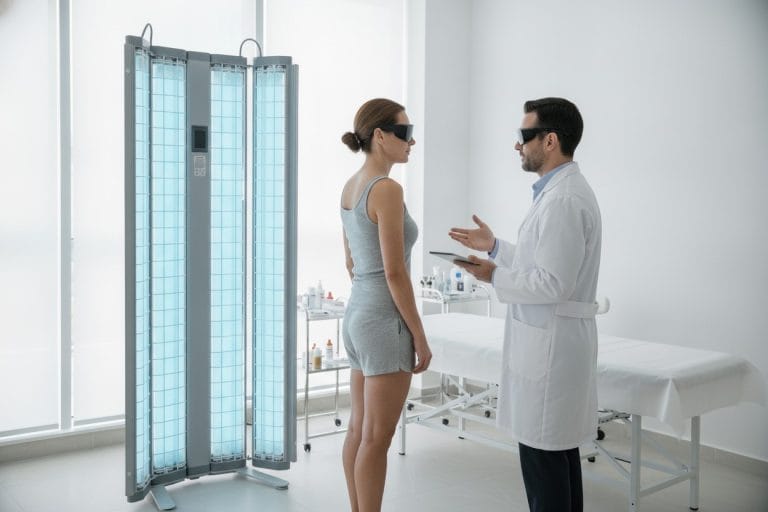
It’s also worth being realistic about what maintenance requires. Dozens of sessions over a year or more is a lot of trips to a clinic. This study didn’t look at where patients were treated, so it says nothing about home versus office phototherapy. But for patients whose physician recommends long-term maintenance, a prescribed home unit can make that schedule much easier to keep. We’ve written about what a typical UVB treatment schedule looks like and how home UVB fits into autoimmune care.
Cytokind’s home units are narrowband UVB, built on Phothera hardware and prescribed by your physician, who sets the protocol. If you’d like to talk through whether home phototherapy could fit your treatment plan, contact us and we’ll help you work through it with your doctor.
This blog post is for informational purposes only and does not constitute medical advice. Individuals should consult with qualified healthcare providers before beginning any new treatment modality.