
Most of what dermatologists know about narrowband UVB for psoriasis comes from studies of patients with lighter skin. That’s a real gap. Psoriasis affects about 1.9% of Black adults and 1.6% of Hispanic adults in the United States, it’s often misdiagnosed in darker skin, and Black patients tend to have more severe disease by the time it’s diagnosed.
A team led by Mio Nakamura set out to collect everything published on narrowband UVB for psoriasis in patients with skin of color. It’s the first systematic review to do that, and the headline is encouraging.
What The Review Did
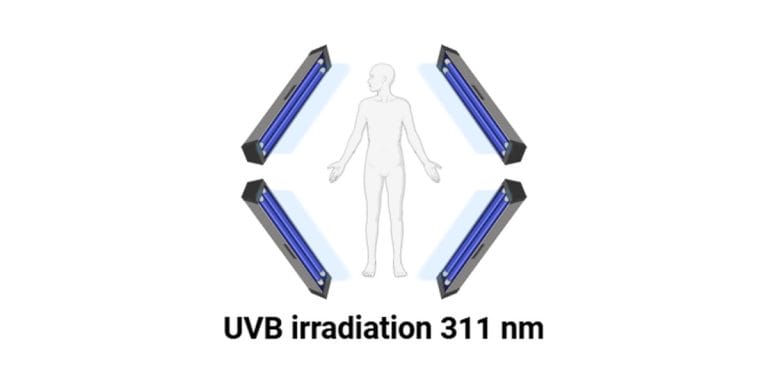
The authors searched the medical literature through November 2024 for studies of UVB and psoriasis in countries where most people have Fitzpatrick skin types III to VI, the medium-to-dark end of the scale dermatologists use to sort skin by how it reacts to sun. They screened 1,283 papers and kept 54.
Of those, 43 reported how patients actually did on treatment, covering 1,334 people with psoriasis. Most of the studies came from Egypt, India, Thailand, Vietnam and Iran. Treatment ran anywhere from twice a week for eight weeks to three times a week for 12 weeks.
What They Found
Every one of the 43 studies found a statistically significant improvement in psoriasis severity after narrowband UVB.
Nine studies reported the standard benchmark, PASI 75, which means a 75% drop in the Psoriasis Area and Severity Index. Pooled together, 70.5% of patients reached it. For comparison, the authors cite an earlier review that put the figure at about 62% for UVB across all patients.
The review also compared narrowband with other kinds of phototherapy. Narrowband cleared psoriasis completely more often than broadband UVB (81% vs 67% after 50 sessions in one study). Against PUVA, the older treatment that pairs a light-sensitizing drug with UVA light, it worked about equally well, and in one study it got there faster and with a much smaller total dose.
What The Review Can’t Tell You
The 70.5% figure rests on nine studies, all from Asia, and it shouldn’t be read as a promise for every patient.
The authors are open about the gaps. None of the studies included anyone with type VI skin, the darkest on the scale, and only a few included type V. The studies used different schedules and doses, so they don’t line up neatly. Redness is harder to see on darker skin, which means side effects may have been undercounted.
They also mention hyperpigmentation, meaning darker patches of skin after treatment. Some patients may not want that trade, and it’s worth raising before starting.
Why Dosing Matters More Here
Darker skin tolerates more UVB before it burns, so it usually needs more of it to work. The review lays out the American Academy of Dermatology and National Psoriasis Foundation guidance: a starting dose of 800 mJ/cm² for skin types V and VI, compared with 300 for types I and II, and a ceiling that’s higher too.
That’s why a treatment plan built for one patient shouldn’t be copied for another. The protocol has to fit the person’s skin, and a clinician should be watching how it responds, especially early on.
What This Means For Patients
If you have darker skin and psoriasis that creams haven’t controlled, this review is good evidence that narrowband UVB belongs on the list of options, alongside biologics and other systemic drugs. The authors make the point that it matters most for people who can’t get those drugs or would rather not take them.
It’s also worth asking your dermatologist directly how your skin type changes the plan: the starting dose, how fast it goes up, and what to watch for.
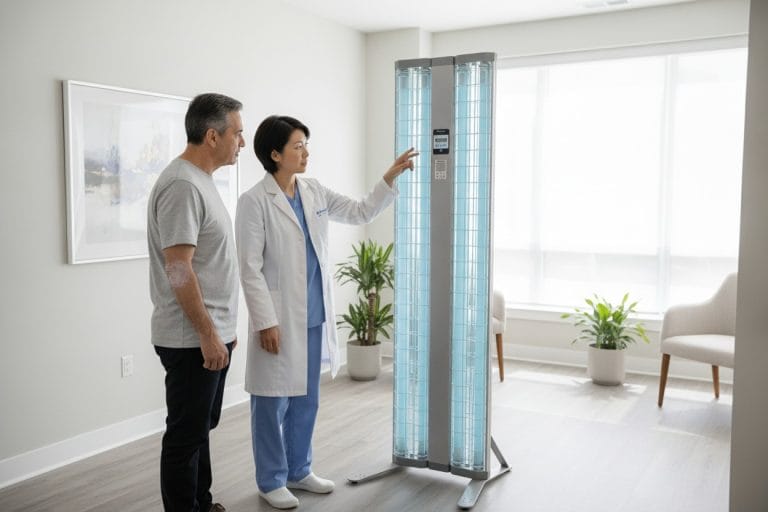
Cytokind’s home units are narrowband UVB, built on Phothera hardware, FDA-cleared and prescribed by your physician who sets the protocol. We covered who is a good fit for home treatment earlier this month. If you want to know whether phototherapy is right for you, talk to us and we’ll help you work through it with your dermatologist.
This blog post is for informational purposes only and does not constitute medical advice. Individuals should consult with qualified healthcare providers before beginning any new treatment modality.