The evidence that home narrowband UVB works for psoriasis is no longer the interesting question. The LITE trial settled it in 2024, and we covered those results when they came out. The question dermatologists are now asking is a practical one: which patients should be doing this at home, on what schedule, and with what safeguards? A review from Jashin Wu’s group at the University of Miami, with co-authors at Kaiser Permanente, Loma Linda, and four other centers, is the first attempt to answer it in one place.
How the Review Was Done
The authors searched PubMed and Embase for everything published on home phototherapy for psoriasis between January 2020 and March 2026 and kept 12 studies: one randomized trial, several observational cohorts, cost analyses, two implementation reports, a patient survey, and a bench comparison of devices. Then they graded the evidence by study design.
What it produces is a candidate checklist, a dosing protocol, and three uncomfortable gaps.
Who Is A Good Candidate
The review sets out seven conditions, and the authors intend all of them to be met:
- A confirmed diagnosis of stable plaque or guttate psoriasis, with a clinical reason to use phototherapy.
- Age 12 or older. Children under 12 were excluded from the LITE trial, so there is no trial evidence for them.
- Difficulty getting to in-office treatment, whether through distance, transportation, work, caregiving, or cost.
- No rapidly progressive, erythrodermic, or pustular psoriasis. Those forms need closer supervision than a home unit allows.
- The health literacy and cognitive capacity to operate the device and follow a dosing protocol.
- Reliable follow-up, in person or by telehealth.
- Stable housing with room to store and use the unit safely.
The third condition deserves a pause. The authors report that roughly 89% of U.S. counties have no phototherapy facility at all. For most American patients, the choice is not home versus office. It is home versus nothing, or home versus a drug.
Who Was Excluded
The exclusions are the part of this review most likely to change a prescribing decision:
- A personal history of melanoma or non-melanoma skin cancer, or extensive sun damage.
- Any photosensitivity disorder, current or past: lupus, dermatomyositis, porphyria, polymorphous light eruption, and the rarer genetic conditions.
- Concurrent photosensitizing medication. The review’s list includes tetracycline antibiotics, fluoroquinolones, thiazide diuretics, NSAIDs, sulfonamides, phenothiazines, and systemic retinoids. A patient on doxycycline for acne or a thiazide for blood pressure needs that reconciled before the first session.
- Cognitive impairment, significant psychiatric illness, or active substance use.
- Unreliable follow-up, which the authors define as inability or unwillingness to take part in scheduled monitoring.
The Dosing Rules
For the physician writing the prescription, the review consolidates the protocol most centers already use:
Starting dose by Fitzpatrick skin type: 130 mJ/cm² for types I and II, up to 400 mJ/cm² for types V and VI, or an in-office minimal erythema dose test before the patient goes home.
Escalation of 10% to 15% per session when there is no redness.
Frequency of three sessions a week on non-consecutive days, with response assessed at four to eight weeks and again at 12 to 16.
Redness is graded. Mild redness that resolves within a day: hold the dose, do not escalate. Redness lasting 24 hours or causing discomfort: stop and call the provider. A moderate or severe reaction: cut the dose by 25% to 50% or pause pending assessment.
Missed sessions get their own rule. A gap under a week, continue as is. One to two weeks, reduce the dose by 25%. More than two weeks, reduce by half or restart from the initial dose.
Erythema (itching) was the most common adverse event in every study reviewed. In LITE it was persistent in 5.9% of home patients against 1.2% in the office, and nobody discontinued because of it. In a 134-patient cohort using handheld units, it occurred in 12.7%, with itch in 5.2%. No study reported blistering, hospitalization, or a treatment-related skin cancer.
The Over-The-Counter Problem
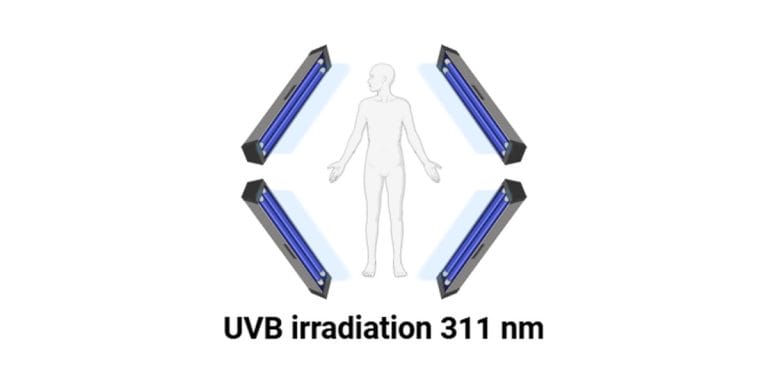
One of the 12 studies is a 2025 bench comparison of prescription NB-UVB units against the unregulated devices sold online. Both peaked at the therapeutic wavelength of about 311 nm. The over-the-counter units were roughly ten times cheaper and, in the bench test, put out higher irradiance. They also lacked the integrated timers and safety fail-safes built into prescription units.
The authors’ conclusion is careful: no human data compares the two, so no clinical recommendation about the cheaper devices can be made. They note the equity argument for them and decline to endorse it. Higher output with no timer is the combination that produces the burn the dosing rules above are designed to prevent, and the rules assume a device that enforces them.
Three Gaps The Authors Will Not Paper Over
No long-term skin cancer data. Not one of the 12 studies tracked cumulative UV dose or skin cancer outcomes. Follow-up ran from three to 30 weeks. The authors write that no conclusion about the long-term skin cancer safety of home NB-UVB can be drawn from the available data. Decades of office-based NB-UVB experience are reassuring, but that is a different evidence base, and this review is honest that home use has not yet built its own.
The equity paradox. The patients with the most to gain from not traveling are the same patients most likely to be blocked by device cost, prior authorization, insurance denials, and unstable housing. The review notes that biologics often cost a patient less out of pocket than a home unit, even though they cost the system far more, which quietly pushes patients toward the drug. LITE and most of the cohorts enrolled motivated patients at academic centers who consented in English; the authors say that population may not reflect who could benefit.
Nobody has studied the cheap devices. See above.
What This Means For Patients And Physicians
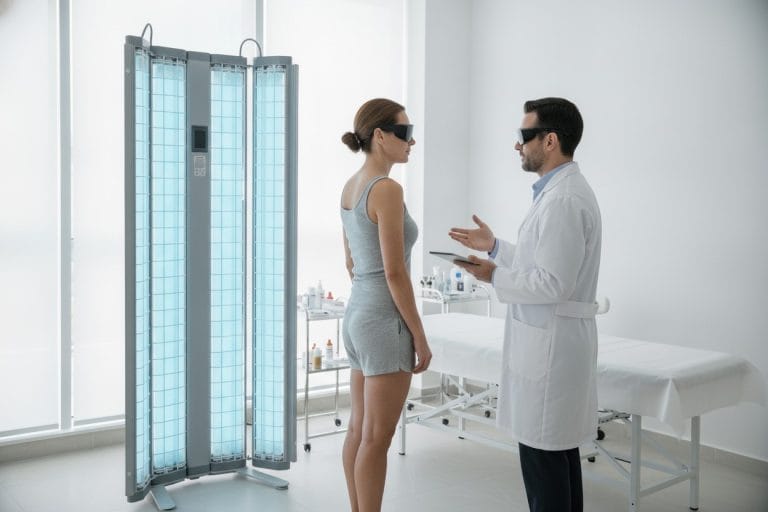
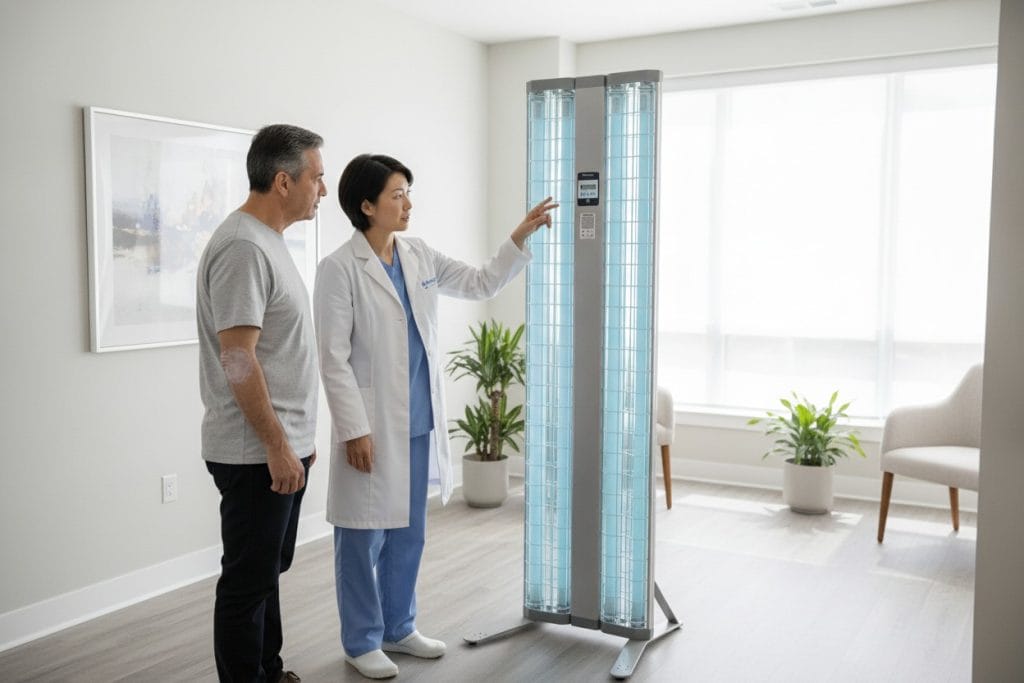
The FDA-cleared, physician-prescribed home NB-UVB unit sits inside the population this review describes: stable plaque or guttate psoriasis, age 12 and up, no photosensitizing condition or medication, a follow-up plan, and a device that meters its own dose. For that patient the review’s verdict is that home treatment is safe, effective, and underused.
The checklist is also the honest answer to a question we get from patients who have already decided. Some should not be doing this at home, and the exclusions above are the reasons. If any of them applies, that is a conversation with your dermatologist before a device is ordered, not after.
Cytokind’s home devices run on industry-leader Phothera hardware and are dispensed by prescription, with the metered dosing and timers the review distinguishes from over-the-counter units. Our team helps patients and prescribers with the protocol, the paperwork, and the follow-up. Get in touch if you want to talk through whether home phototherapy fits.
Three Things Worth Taking From This
1. Selection is the whole game. The review’s seven criteria and six exclusions are the first consolidated checklist for home NB-UVB. Photosensitizing drugs, especially common ones like doxycycline and thiazides, are the exclusion most often missed.
2. The dosing rules assume the device enforces them. A timer and a metered dose are what separate a prescription unit from a cheaper one that puts out more light. And if you have health insurance, chances are high that you will pay little or nothing for light unit.
3. Long-term safety at home is still an open question. Office NB-UVB has decades behind it. Home NB-UVB has 30 weeks. Follow-up is not optional.
This blog post is for informational purposes only and does not constitute medical advice. Individuals should consult with qualified healthcare providers before beginning any new treatment modality.