
Narrowband UVB Changed Immune Cells Far From The Skin. In MS, Less Of The Signal Got Through.
Multiple sclerosis becomes more common the farther people live from the equator. Researchers have known this since the 1960s, and the usual explanation is less sunlight, which means less vitamin D. But vitamin D supplements have produced only modest results in MS trials, which leaves an open question: is light doing something that a vitamin D pill does not?
A team at the University of Münster in Germany set out to look directly. They gave people narrowband UVB, the same 311 nm light used to treat psoriasis, and then examined their immune cells one at a time, in the skin, in the blood, and in some participants, in the fluid around the brain and spinal cord.
What The Study Did
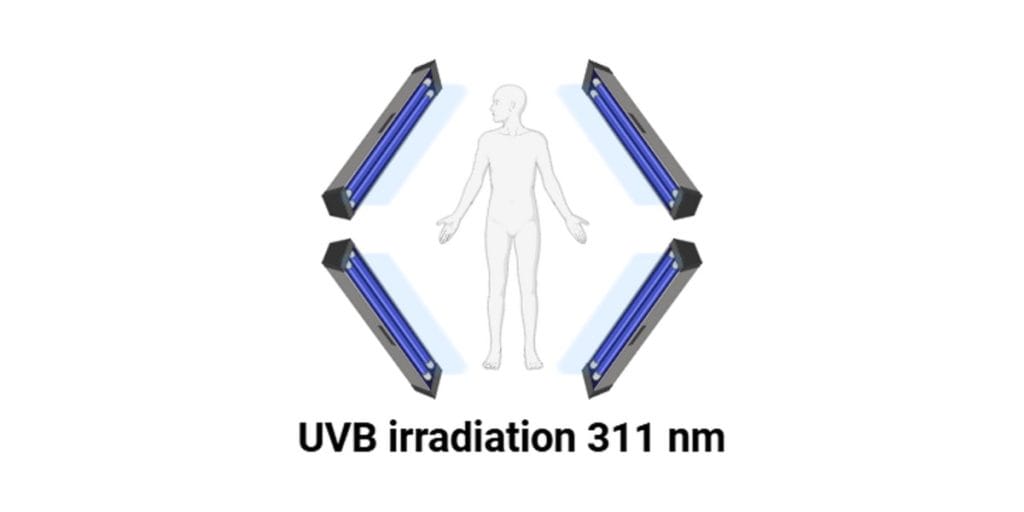
The study, called SMILE, enrolled 11 people with relapsing-remitting MS and 7 healthy volunteers. Everyone received full-body narrowband UVB on weekdays for four weeks in a hospital phototherapy cabinet, during the German winter so that natural sunlight would not muddy the results. The dose started below each person’s burning threshold and rose gradually.
Before and after the four weeks, the researchers took a small skin biopsy and a blood sample from every participant. Four volunteers, three with MS and one healthy, also agreed to a spinal tap before and after. In total, the team analyzed more than 380,000 individual immune cells, and they read the genetic fingerprint of T cells so they could follow the same cells as they moved from one part of the body to another.
What They Found
The effects did not stay in the skin. UVB is absorbed in the outer layer of skin, yet the immune changes reached the bloodstream. B cells, which are a major target of several MS drugs, fell from 13% to 10% of immune cells in the blood. Genes in the vitamin D receptor pathway switched on in every major type of blood immune cell, and markers of regulatory T cells, the cells that keep the immune system from attacking the body, rose in both skin and blood.
Some cells traveled from the skin to the spinal fluid. By tracking individual T cells, the team found clones that appeared in the skin and later showed up in the blood, and 25 that turned up in the spinal fluid after treatment. In the MS patients, a group of T cells that live in the spinal fluid shifted toward a profile associated with interferon-beta, which is itself an approved MS treatment, and became more regulatory and less like the cells typically seen in MS. That finding rests on three MS patients, so it is an early observation, not a result.
In MS, less of the signal got through. This is the headline the authors chose, and it is the part worth reading slowly. The skin of people with MS reacted to UVB more strongly than the skin of healthy volunteers. But the calming changes in the blood were noticeably weaker in MS. Fewer T cells made the trip from skin to blood, and genes linked to immune balance and tissue repair rose in healthy volunteers’ blood but stayed flat in the MS patients. Vitamin D levels also rose less in the MS group.
How To Read This
It would be easy to turn “the response was weaker in MS” into “UVB doesn’t work in MS.” The study does not say that, and neither do its authors. What it says is that the pathway from light on the skin to calmer immune cells in the rest of the body appears to be partly impaired in MS. The authors suggest people with MS may need more light, a longer course, or light combined with vitamin D to get the same systemic effect a healthy person gets. They note that MS patients with higher vitamin D levels looked more like the healthy volunteers.
That is a hypothesis to test, not a treatment recommendation. It is also a more useful finding than a simple yes or no, because it points at what future trials should measure.
What This Study Cannot Tell Us
This was a study of immune biology, not of symptoms. It did not measure relapses, fatigue, disability, or brain scans. It included 18 people, ran for four weeks, and followed no one afterward. The MS participants were on a mix of disease-modifying drugs, and the spinal fluid results come from four people. It measured gene activity, which does not always translate into protein levels or cell function.
The clinical side of the question is being studied separately. An Australian trial in people with the earliest form of MS looked at disease activity and fatigue after narrowband UVB, and we covered the researchers’ overview of that work here. Cytokind’s CEO, John MacMahon, is a co-author of that overview.
Why It Matters
For decades the case for light in MS has rested on geography and vitamin D. This study adds something more direct: controlled, medical-grade UVB on the skin measurably changed immune cells in the blood and, in a few people, in the spinal fluid.
Narrowband UVB is FDA-cleared for skin conditions such as psoriasis, eczema, and vitiligo. Its use for MS is still being researched and it is not an approved MS treatment. If you have MS and want to follow this research or talk through whether phototherapy could ever fit your care, get in touch, and keep your neurologist in the conversation.
This article summarizes published research and is not medical advice. Phototherapy is a prescription treatment. Talk with your doctor about whether it is appropriate for you.
Featured image: cropped from Figure 7 of Falk et al., Journal of Neuroinflammation, 2026, published under a Creative Commons Attribution 4.0 license.