 By Larry Luxner |
Publish Date: July 20, 2026
Republished with permission from Rare Disease Advisor
Ryan Roy, 42, a resident of Concord, New Hampshire, was diagnosed last year with relapsing-remitting multiple sclerosis (MS) but has been suffering from its symptoms since 2020.
“Five years ago, I started going numb in my right leg,” said Roy, who runs his own plumbing business. “The following year, it happened to my other leg, then the whole lower half of my body—and then from last year, from the chest down.”
In March 2025, Roy’s doctor put him on a disease-modifying therapy known as ofatumumab (Kesimpta®)—a once-a-month, at-home injection developed by Novartis that targets and depletes B cells to reduce MS relapses and minimize inflammatory brain lesions.
Although the injections slowed progression of his MS, he was still exhausted all the time.
A Man on a Mission
Desperate to improve his situation, Roy—who at the time weighed nearly 300 pounds—changed his poor diet, cutting out all dairy, gluten, and processed foods. He began an exercise program of stretching, bending, light weightlifting, and walking—and within a year lost 100 pounds.
One day while researching his condition online, Roy listened to a podcast on phototherapy featuring John MacMahon, the CEO of Cytokind. The medical device company, based in Intervale, New Hampshire, markets a line of products under the brand name Phothera® that emit narrowband ultraviolet-B (UVB) light, replicating natural sunlight.

Its benefits are cited in a recent study, “Insights from a trial of narrowband UVB for early multiple sclerosis,” published in Photochemical & Photobiology Sciences in March.
Roy reached out to MacMahon and eventually spent $4500 on a light panel, paying out of pocket because his insurance would not cover the experimental therapy.
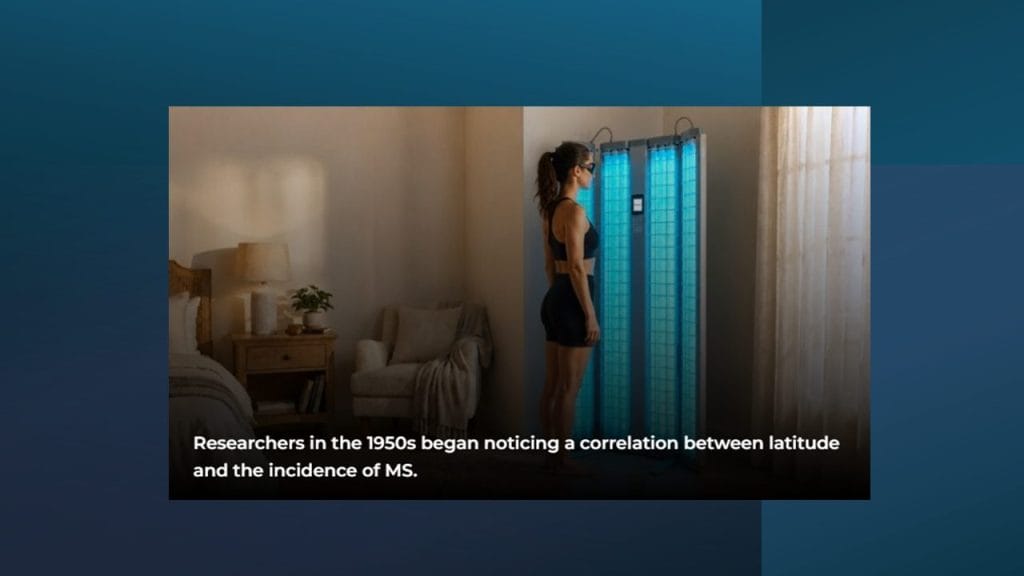
“It’s a 4-foot by 2-foot light panel, and you stand in front of it for about 12 minutes total every morning,” he said. “It’s like being out in the sunshine for half an hour. It creates the vitamin D you need, and it’s way better than taking drops, because you’re supposed to absorb vitamin D through your skin.”
Roy said that adding daily phototherapy sessions to his routine has boosted his energy, mood, and overall quality of life, especially during the long New England winter months.
“I have an incredible amount of energy versus what I had before. My mood is much better. I went through this whole past winter without having a relapse,” he said. “The shot that I take is supposed to suppress relapses as well, so I don’t look at phototherapy as something that stops the problem, but as a helpful tool.”
MS Incidence Increases With Distance From Equator
Launched in 2021 at the height of the COVID pandemic, Cytokind calls itself “the global leader in using UVB light to treat immune disorders and improve survival and quality of life for patients.” The technology has already received clearance from the US Food and Drug Administration (FDA) for psoriasis and eczema, but not yet for MS.
MacMahon said Cytokind’s technology is particularly useful in MS, which is sensitive to light exposure. Research has found that the frequency of MS also strongly correlates with latitude.
“Starting in the 1950s, researchers in and around the MS field began noticing what they call a latitude gradient—meaning that either way you move away from the equator, you’re going to get an increase in the incidence of MS,” he explained. “You’ll get an earlier diagnosis, and you’ll have a much more severe disease.”
MacMahon added, “That gradient is so great that there’s, in essence, no MS near the equator. If you cut the US in half, from the upper half to the lower half, the incidence is twice as much.”
But distance from the equator is not the only factor, he noted. Syracuse, New York—which has the highest incidence of the disease among US cities—isn’t only located at a higher latitude, but also sees extensive cloud cover.
“If you live in a Great Lakes region or a coastal region with overcast skies, you’ll get less UVB light,” he said. “In the winter, when the sun’s low on the horizon, it just doesn’t penetrate the atmosphere as much. That tracks directly into prevalence in and around MS.”
A ‘Sunlight Deprivation’ Disease
Richard Weller, MD, is a professor of medical dermatology at the University of Edinburgh in Scotland. He said that even when he was studying medicine in the 1980s, MS was known as a “sunlight deprivation” disease.
“I’m a dermatologist—not a neurologist—and I started off believing that sunlight was an unmitigated evil, and that you should never let it touch you,” he said. “But the data made me realize that we have it completely upside down.”

According to Dr. Weller, Scotland has the highest incidence of MS in the world, and the Orkney Islands—a windswept archipelago off the northern Scottish coast—have the highest rate within Scotland, at roughly 1 in 400 inhabitants. Other countries with unusually high rates of MS are Canada, Ireland, Norway, and Sweden—all located north of the 45th parallel.
“The benefits of sunlight vastly outweigh the risks,” he told Rare Disease Advisor by phone. “We published 2 years of data from the UK Biobank, an epidemiological study that looked at half a million Britons. We found that people who get more sunlight have markedly reduced all-cause mortality—from MS, type 2 diabetes, cardiovascular disease, and cancer.”
This is why, he said, middle-aged Britons who use tanning beds statistically live longer than those who don’t—even though tanning beds are a known risk factor for melanoma.
An ‘Apparent Contradiction’
“Dermatologists have used narrowband UV therapy for more than 40 years to treat inflammatory skin diseases. We don’t know how it works. It just does,” he said. “The effect is probably systemic. When we give people phototherapy, we can actually measure systemic changes in immune function.”

Dr. Weller said this apparent contradiction is analogous to smoking, which is known to reduce anxiety—yet doctors never advise people to smoke.
“People in the UK who get the most sunlight are more likely to die of skin cancer. However, when you look at death from any cause, people who get the most sunlight are much less likely to die overall,” he explained. “For every skin cancer death you prevent, you’d have 100 extra deaths from cardiovascular disease, cancers, and conditions like MS.”
The controversy coincides with this year’s release of the book In Defense of Sunlight: The Surprising Science of Sun Exposure. Its author, Rowan Jacobsen, boils his research down to 7 words of advice: “Get sun. Not too much. Go outside.”
MacMahon noted that at the 2024 Consortium of Multiple Sclerosis Centers (CMSC) Conference, Ahmed Obeidat, MD, PhD, presented Cytokind’s PhoCIS trial data showing that at‑home narrowband UVB was linked with improvements in MS disease activity scores and meaningful reductions in fatigue in people with MS.
Roy can certainly relate to that conclusion.
“Phototherapy has helped me stay active with my kids and keep showing up for my business, alongside the treatment plan my neurologist and I put in place,” he said. “I’m hopeful that with more research and eventual FDA approval, this could become a more widely accessible option for others living with MS.”
Larry is a freelance journalist and photographer who specializes in covering the rare disease community.