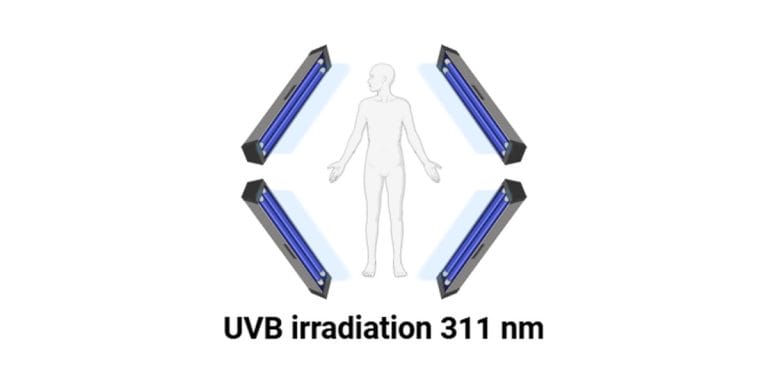

For most of the last century, official advice about the sun has had one direction: less. Seventeen researchers from institutions in ten countries now argue that this advice ignores half the evidence. Their review, published in Photochemical & Photobiological Sciences, comes out of an expert meeting held in Washington, D.C. in May 2024, and it assembles the case that ultraviolet light does far more in the body than make vitamin D.
This one is close to home. Among the seventeen authors is Professor Richard Weller of the University of Edinburgh, a science advisor to Cytokind, whose UK Biobank mortality research we covered in March. That work appears here too, alongside sixteen colleagues’ worth of evidence from dermatology, cardiology, neurology, and immunology.
What The Paper Is
This is a narrative review, not a new trial. Each author presented current research at the 2024 meeting, and the paper stitches those presentations into one inventory of what is known about UV exposure and health. That format has real limitations, which we will get to. Its strength is the assembly: findings that usually live in separate journals, argued as one case.
Regular readers have already met parts of it. The UK Biobank analysis linking higher UV exposure to lower all-cause, cardiovascular, and cancer mortality is the study behind our March post. The PhoCIS trial of narrowband UVB in early multiple sclerosis is the one we wrote about here. And the review’s central argument, that vitamin D supplement trials keep failing to reproduce what sun exposure shows in population data, so the mechanism must run through other channels, is the argument John MacMahon laid out in his essay on light-driven immune modulation in June.
So rather than retell those, here is what the review adds that we have not covered before.
What’s New Here
Two decades of Swedish data. The Melanoma of Southern Sweden cohort followed 29,000 women for twenty years. Those with the lowest sun exposure had roughly double the risk of death compared to those with the highest, and the high-exposure group had a 50% lower risk of cardiovascular death. The finding held when women with existing illnesses were excluded.
Blood pressure numbers, from trials. Skin exposed to UV releases stored nitric oxide, which relaxes blood vessels. One cited trial found ambulatory blood pressure dropped about 6 mmHg after six weeks of UVB sessions three times a week; UVA alone did not do it. In the Swedish cohort, the lowest-sun group was 41% more likely to be on blood pressure medication five years later.
Graft-versus-host disease. A 2024 meta-analysis of phototherapy for GvHD found narrowband UVB had the highest response rate of the modalities studied (94%), the fewest adverse events (8%), and the shortest treatment course.
An at-home NB-UVB trial is underway. The early MS results have led to a phase 2 randomized placebo-controlled trial of narrowband UVB for MS fatigue, using at-home NB-UVB units. The authors close by explicitly recommending further research on narrowband UV devices “to explore their potential in reducing morbidity and mortality in a multitude of diseases.”
The Honest Part
Almost all of the mortality evidence here is observational. People who get more sun differ from people who get less in ways no statistical adjustment fully removes, and the authors say plainly that randomized trials “are still required to establish causality.” The small trials are small: PhoCIS enrolled 20 people. The meeting itself was sponsored by the Sunlight Health Foundation, an organization convened around sunlight’s benefits, though it had no role in drafting the paper and paid no speaker fees.
None of this makes the findings wrong. It makes them a case for more research, which is exactly what the authors claim, no more.
What This Means, And Does Not Mean
NB-UVB phototherapy is FDA-cleared and physician-prescribed for skin conditions such as psoriasis. Its use in multiple sclerosis, graft-versus-host disease, and blood pressure is investigational: promising early trials, not approved treatments. Nothing in this review changes what a home phototherapy device is cleared to treat, and nobody should substitute sun or UV exposure for prescribed therapy in any of these conditions.
Disclosure: Professor Richard Weller, an author of the review, is a science advisor to Cytokind. The review was produced independently of the company.
Questions Patients May Ask
“Should I stop using sunscreen?” This review does not say that. The authors argue for balanced advice on “mild to moderate” exposure, adjusted for skin type, season, and latitude. Excessive UV remains a carcinogen, and they acknowledge the skin cancer risk throughout.
“My phototherapy is for psoriasis. Is it also helping my blood pressure or immune system?” Possibly, and researchers are actively studying exactly that question, but the systemic effects are not established well enough to count on. Treat them as a subject of research, not a second indication.
Three Things Worth Taking From This
1. Vitamin D pills are not bottled sunlight. The supplement trials keep failing to match the observational benefits of sun exposure, which points to pathways (nitric oxide, immune regulation) that only light reaches.
2. The interesting NB-UVB research has left the skin. MS, graft-versus-host disease, and blood pressure trials are underway or complete, and one is testing at-home NB-UVB units.
3. Read the direction, not the destination. Seventeen researchers arguing that public health advice should weigh UV’s benefits is a shift worth knowing about. It is not yet a change in what any device is cleared to do.
This blog post is for informational purposes only and does not constitute medical advice. Individuals should consult with qualified healthcare providers before beginning any new treatment modality.