
If you have an autoimmune or inflammatory condition, you’ve likely heard the warnings: be careful with UV light. Avoid solariums. Minimize sun exposure. It’s advice given with good intentions — but a landmark 34-year study involving nearly 29,000 women suggests the story is significantly more complicated than that.
What The Research Found On Controlled UV Exposure & Mortality
The Melanoma of Southern Sweden (MISS) cohort is one of the largest and longest-running studies of UV exposure and health outcomes ever conducted. Researchers enrolled nearly 29,000 women in 1990 and tracked them for up to 34 years.
The critical innovation in this study was that the researchers separated two groups that earlier research had always lumped together.
Group 1: Solarium users who did not engage in high-risk sun behaviors — no repeated burns, no excessive outdoor tanning, no sun-seeking vacations.
Group 2: Solarium users who also engaged in those risky sun behaviors.
By separating these groups, researchers could finally answer a question previous studies could not: Is UV light exposure itself the risk, or is the risk concentrated in how people behave around UV light?
What The Data Showed
No increased melanoma risk. When risky sun behaviors were not part of the picture, solarium use had no meaningful impact on melanoma incidence compared to people who never used one.
18% lower all-cause mortality. Whether or not they had risky sun behaviors alongside their solarium use, UV light users had approximately 18% lower risk of dying from any cause compared to non-users.
Nearly 10 months longer. Solarium users lived an average of nearly 10 months longer over the 25-year follow-up period.
No difference in melanoma-specific mortality. The rate of melanoma-related deaths did not differ meaningfully between UV light users and non-users.
One-third of melanomas traced to behavior, not devices. About one-third of melanomas were attributable to risky sun behaviors — not to solarium use itself.
The Really Good News
The most important word in the findings above is “behavior.”
The risk that previous research attributed to UV light was substantially driven not by UV exposure alone, but by how people behaved around it — seeking burns, maximizing sun time, treating UV as a recreational goal rather than a controlled input. When those behaviors were removed from the equation, the risk picture changed dramatically.
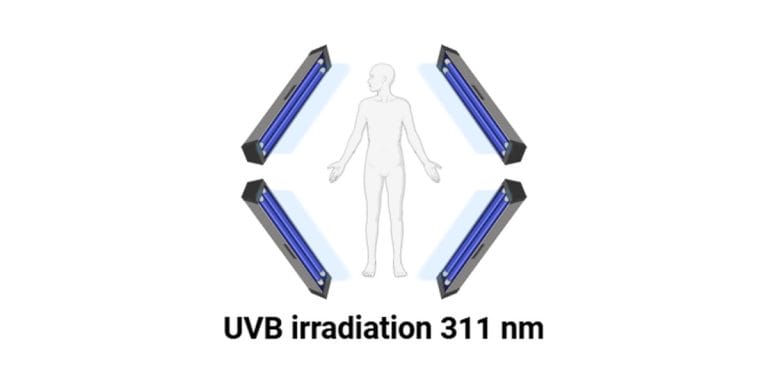
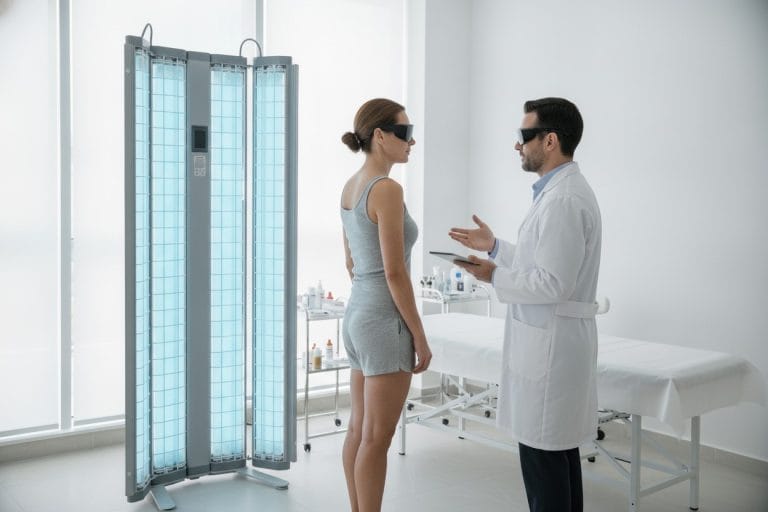
For patients using physician-prescribed NB-UVB phototherapy, this matters directly. NB-UVB treatment is calibrated, medically supervised, and designed to deliver a specific therapeutic dose. It is not recreational tanning. The MISS cohort data suggests that controlled, non-reckless UV exposure carries a risk profile that looks fundamentally different from the behaviors that drove earlier warnings.
And there is a signal in this data worth paying attention to: 18% lower all-cause mortality means UV light users, on average, were dying less from everything — not just sun-related causes. Researchers have proposed mechanisms including Vitamin D regulation, immune modulation, and cardiovascular effects. The MISS study doesn’t resolve which mechanism is driving the effect. But it documents, across nearly three decades of follow-up, that the effect is real and consistent.
Talking With Your Doctor
This study is worth bringing to your next appointment — not to challenge your doctor’s judgment, but because this data is new, specific, and directly relevant to the UV conversation most patients with autoimmune conditions eventually have.
Before this study, most UV exposure research couldn’t separate controlled device use from risky behavior. This one did. And the results landed differently than the prior consensus.
Some questions worth raising:
How does this study change the risk-benefit picture for UV light therapy in my situation?
- Are the UV risks I’ve been warned about based on studies that included risky sun behaviors, or just controlled device use?
- Is there emerging evidence supporting NB-UVB for my specific condition?
- Your physician has your full history and knows your condition. These questions are meant to open a conversation — not direct it.
What This Means For You
Managing an autoimmune or inflammatory condition means living with trade-offs. Treatments come with side effects. Evidence is still emerging. The advice you receive is often calibrated to general populations, not your specific situation.
What this study offers is precision. It says: we looked at nearly 29,000 people for 34 years, and when we isolated controlled UV exposure from risky sun behavior, the feared outcome — higher mortality — didn’t materialize. The opposite did.
If phototherapy is part of your treatment plan or on your radar, you now have a 34-year, 29,000-person data set behind that conversation with your doctor. That matters.
The science on UV light has been telling a simpler story than the evidence supports. This study adds a chapter that anyone navigating phototherapy deserves to read.
This blog post is for informational purposes only and does not constitute medical advice. Individuals should consult with qualified healthcare providers before beginning any new treatment modality.